Hawaii Volcanoes National Park: A Day Trip from the Kohala Coast
Planning a visit to Hawaii Volcanoes National Park from the Kohala Coast: the drive via Hilo, stops on the way, what to bring, safety, and the volcanoes' story.

The water off the Kohala Coast holds whales in winter and manta rays all year. Most of what our guide knew about them came from Honolulu writer and photographer Jennifer Crites, and from a talkative reef shark.
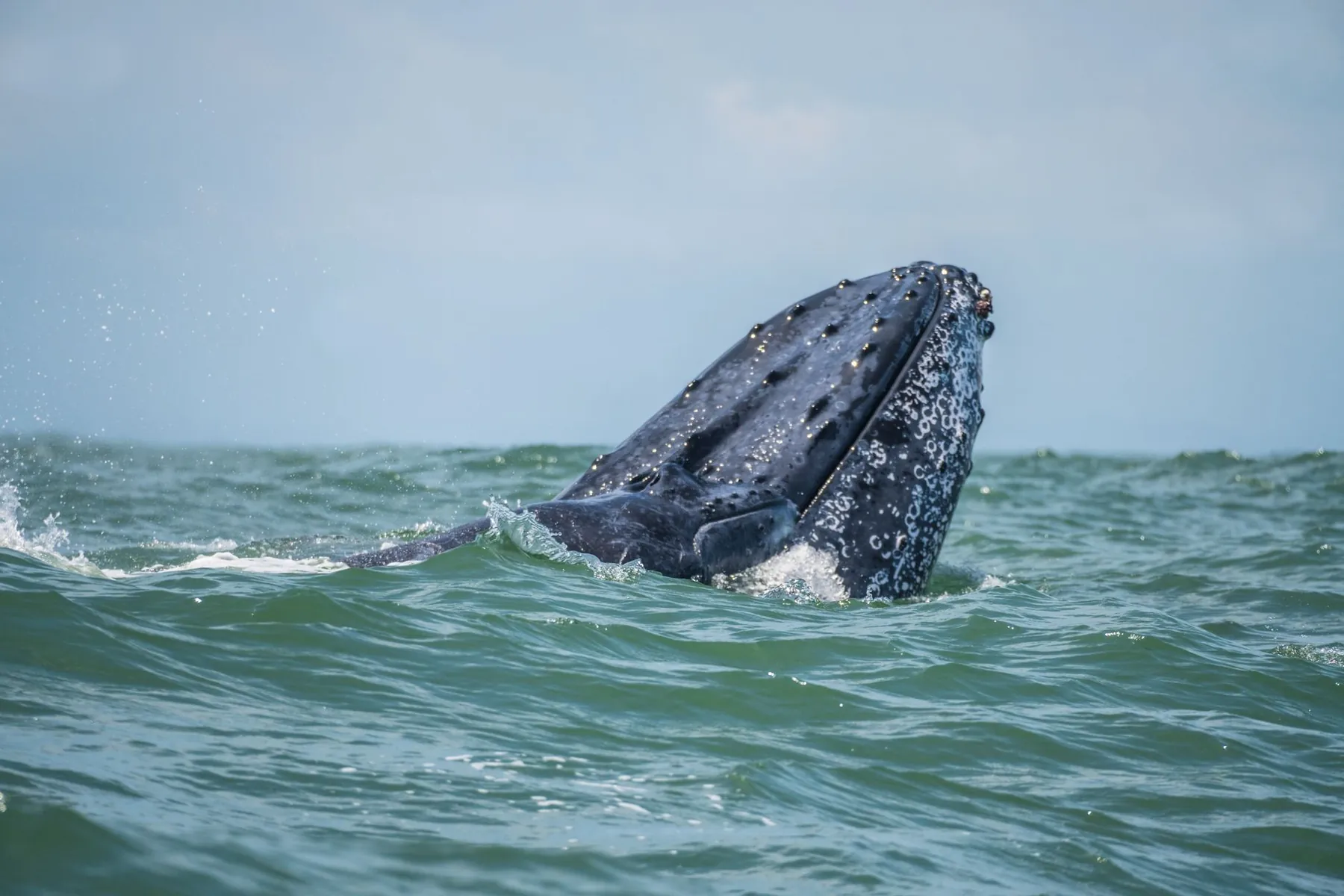
The Kohala Coast has an abundance of tropical sea life, and you meet it first hand by snorkeling or scuba diving off any of our beaches or by going out on one of the boats listed under Kohala Coast activities. People who are afraid of the ocean need not miss out either. There are plenty of ways here to see a lot of sea life without ever putting your face in the water.
Much of this page came to us from a friend of the guide, Jennifer Crites. She is a Honolulu-based photographer and writer whose work ranges from island culture and traditions to contemporary life and science. Her words and pictures have appeared in Hawaii, Honolulu and Islands magazines, in Island Home, Island Scene, Malamalama (the University of Hawaii magazine), Hana Hou! (the Hawaiian Airlines magazine) and Hawaii Parent, among others. With Gerald Crow she wrote, and photographed, the nature book Sharks and Rays of Hawaii (Mutual Publishing, 2002).
Jennifer wrote two pieces for us in the voice of Blackie, a blacktip reef shark with strong opinions and a fondness for long words. Blackie thinks people on hilltops with binoculars ought to be watching sharks instead of whales. In his words, “We’re much more interesting.” Then he tells you everything about whales anyway. What follows is the substance of both stories, retold.
The humpbacks are not here all year, and Blackie suspects that is why people are so taken with them. Like snowbirds, they arrive for the winter, roughly between November and April, then head back to Alaska or wherever else they came from. Each season volunteers are recruited to count them from shore and record their behavior: flukes, spouts, tail slaps. On the North Kohala coast, the months from December to March are when you may see mothers with calves.
The striking thing is that they do not eat while they are here. They swim thousands of miles, give birth, nurse their calves, and swim all the way back on nothing but blubber.
Humpbacks keep to somewhat deeper water than the nearshore reef where a blacktip spends its days, so the two rarely cross paths. Now and then a whale does become food for sharks: a dead whale that washed up on a beach was surrounded by hungry sharks, most likely tigers.
Humpbacks are not the only whales here.
To a reef shark they look like ungainly submarines. An adult is about 45 feet long and weighs roughly 35 tons, which works out to 70,000 pounds. The tongue alone weighs two tons. Even a newborn is a whopper at around 3,000 pounds.
You would expect heavy bones to hold all that together, but a humpback’s bones are very light. Its skeleton is only 15 percent of its total body weight, probably because buoyant sea water does most of the lifting. A land mammal’s bones make up about 50 percent of its body weight.
Humpbacks eat krill, pretty much the tiniest creatures in the ocean, and some small fish. They have no teeth and do not need them for prey that size; swallowing whole works fine. What they have instead is baleen. Hundreds of rigid strips hang from the upper jaw around the inside of the mouth. Their edges are bristly and frayed, and the frayed edges crisscross to trap as much as possible. Sea water floods in, the baleen strains it, and the food stays behind. It works like the filter on a kitchen faucet, except that what it catches is dinner.
Filter-feeding whales come in three kinds:
Humpbacks can be clever about it. When a whale finds a big school of small fish it may dive beneath them and swim in a circle, releasing bubbles from its blowhole. The bubbles rise in a noisy ring, a bubblenet, that confuses the fish and pushes them toward the surface. As the net closes in, the fish bunch together and make a tighter target. Then the whale shoots up through the middle with its mouth open, still blowing bubbles. A humpback can eat nearly a ton of food a day this way.
One more thing Blackie wants settled: whales are not fish like him. They are air-breathing mammals like you, and that is why they have to come to the surface, where you can see them.
Most people lump every ray together as a stingray. There are nine types of rays in Hawaiian waters, including manta rays, devil rays and electric rays, and each one is different.
Electric rays are properly called torpedo rays, though they look nothing like a torpedo and are not stingrays either. They have organs that can deliver an electric shock if touched. Mostly they use it to protect themselves or to stun their food. Swimmers need not worry about meeting one: torpedo rays live 300 to 1,500 feet down.
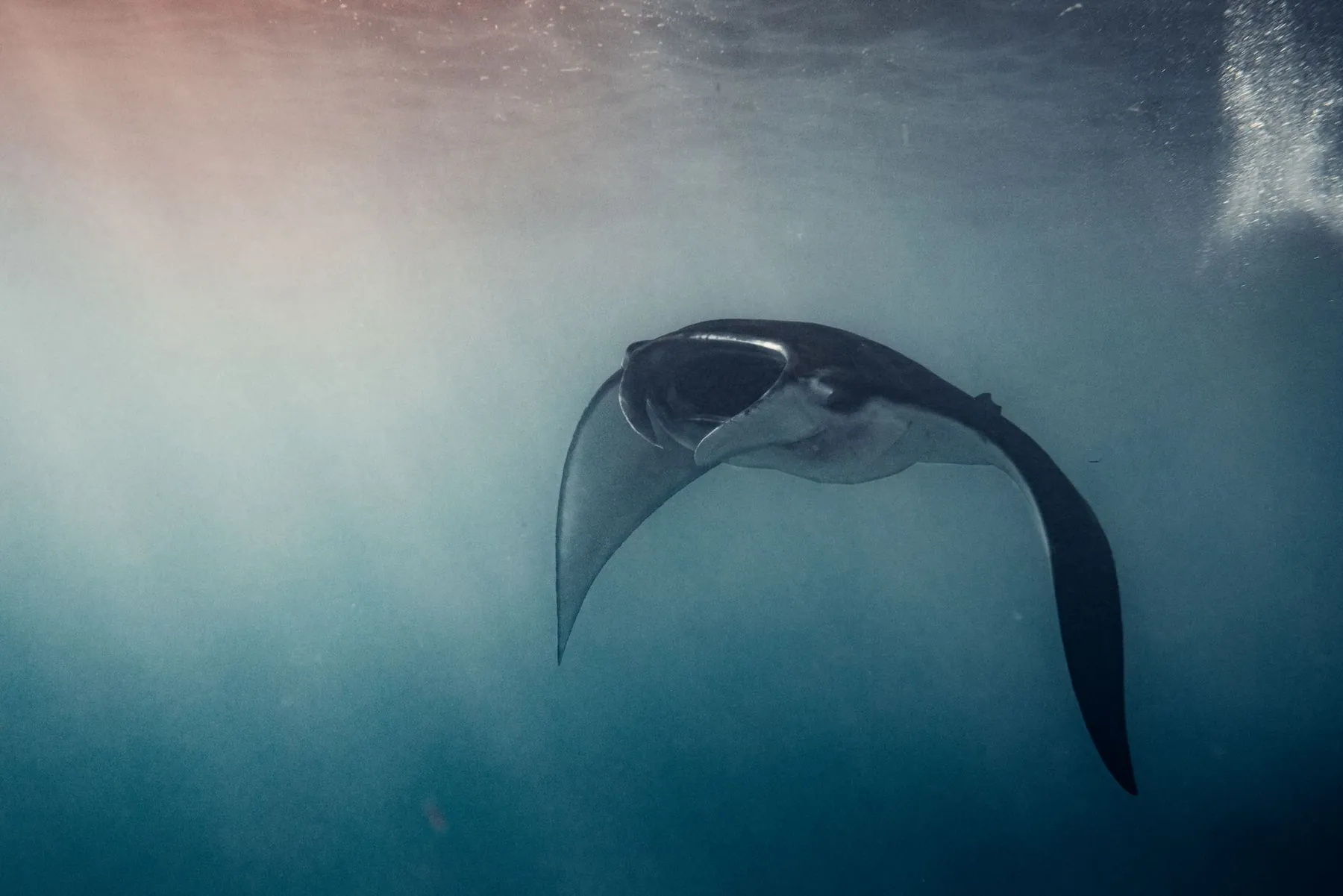
Mantas are not stingrays, and they are one animal down there that is not dangerous. They have no teeth to speak of. They eat plankton. At birth a manta already measures about three feet from wingtip to wingtip, although just before birth the wings are folded around the body, which makes the pup look something like a big bat. On plankton alone they can grow to a wingspan of 22 feet.
They have big mouths, the better to take in the huge quantity of plankton they need. On either side of the mouth is a large flap called a cephalic horn, which helps guide the plankton in. Watching them feed is the thing to see: loop after loop with the mouth wide open, scooping up plankton, nearly as graceful as a shark, Blackie admits.
Jennifer’s book has a story about a Big Island man who went out in his boat to do a little fishing. He dropped anchor in Kealakekua Bay and was about to dive in for a look at a big manta he had just seen when the boat started to move. It took off forward, then sideways, tilting at a frightening angle, with him hanging on. He was glad he had not been in the water, watching his boat leave without him. After being thrown around for a while he managed to cut the anchor line, but not before he saw a large blip on the fish finder and understood that the manta had somehow become caught up in the anchor and was dragging the boat. Blackie’s theory is that the anchor lodged in the manta’s mouth like a hook.
Mauna Kea Beach Hotel. From the hotel’s oceanside terrace you could probably see mantas on most nights. The hotel shone lights on the ocean after dark. The lights lure plankton, and the mantas follow the plankton.
Night dives. Some Big Island dive shops took divers out at night to be in the water with the mantas. There is no need to be nervous about it. They are very gentle, and so absorbed in feeding that they pay little attention to humans.
Lefty. You might even meet her. One of her cephalic horns, the left one, droops, and you cannot miss her.
Four Seasons Hualalai. The resort had a ray lagoon with several spotted eagle rays. Guests could swim in the lagoon, subject to the resort’s rules, and at certain times of day hand feed the rays with the help of a resort employee.
The same pages pointed readers to our blog pieces on big game fishing in Hawaii and to a review of Sharks and Rays of Hawaii, which has many more stories like these. If the mantas have convinced you to get wet, boats, dive shops and snorkel spots are covered under Kohala Coast activities, and the wider list of ocean outings is on Big Island attractions.
Roughly between November and April. They arrive for the winter, give birth to their calves and nurse them here, then swim back toward Alaska. They do not eat for the whole time they are in Hawaiian waters, living off their blubber instead.
No. Manta rays are not stingrays, have no teeth to speak of and feed on plankton. They are very gentle and so absorbed in feeding that they pay little attention to people, which is why dive shops on the Big Island took visitors out at night to dive with them.
From the oceanside terrace of the Mauna Kea Beach Hotel, where lights shone on the water at night drew plankton and the mantas followed. The Four Seasons Hualalai Resort also had a ray lagoon with several spotted eagle rays, where guests could swim and, at set times, hand feed them with a staff member.
Planning a visit to Hawaii Volcanoes National Park from the Kohala Coast: the drive via Hilo, stops on the way, what to bring, safety, and the volcanoes' story.
What to see and do on Hawaii's Big Island: volcano, Mauna Kea summit, historic parks, valleys, diving, fishing and the operators our guide listed in 2013.
Visiting Mauna Kea from the Kohala Coast: the Visitor Information Station, stargazing, summit tours, the road above, altitude risks, weather and what to pack.